


Previous Post
Hi,
I see too many talented entrepreneurs drowning in overwhelm, and it’s not usually because they don’t have enough time.
Don’t get me wrong, they do have very little time. I’m not dismissing the reality that they’re time-starved. Most people are juggling day jobs, families, and the other responsibilities that demand their time.
You genuinely don’t have much time. I get it.
On top of that, humans are great about feeling guilty when they have even the smallest amount of space in their day, and stuffing more and more into the void to numb their anxiety.
But everyone has a little time, right? Otherwise, how would they even have a business in the first place? More often than not they make poor time choices with what little time they do have.
When I coach people who are overwhelmed, what I generally find are people who make terrible time investments.
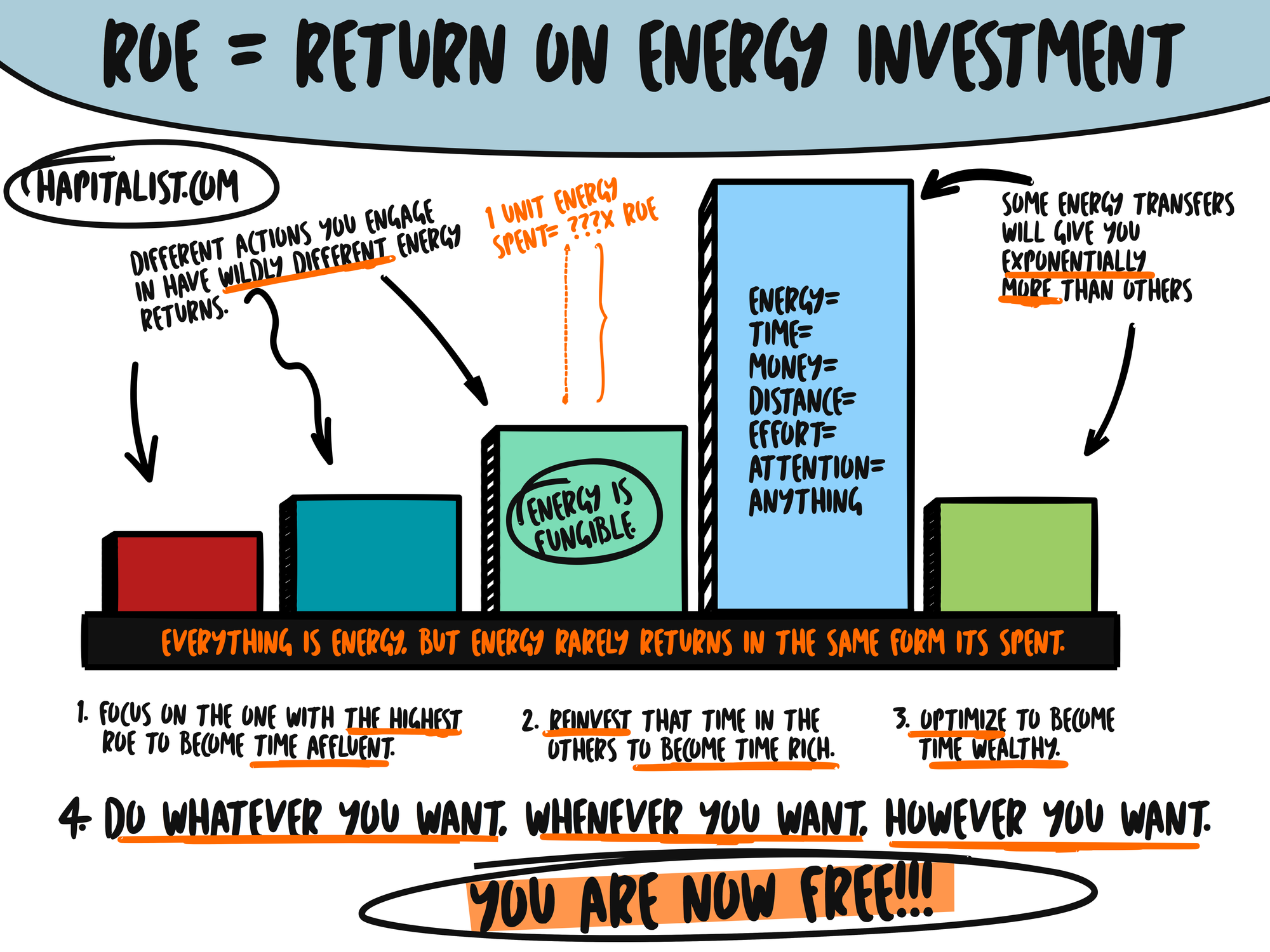
To help those entrepreneurs find frictionless growth, it usually comes down to showing them how to making a better return on their limited energy investment (ROE).
Once we have that sorted, those better investments compound over time and most of the rest takes care of itself.
I’ve identified five primary growth paths that exist outside of creating and shipping products: We call them the S.C.A.L.E. paths.
- (S)potlight (Thought Leadership): You make essays, newsletters, podcasts, and ideas that ripple through your industry. You’re a lighthouse.
- (C)ollaboration (Partnerships): You grow by building with others. You co-create products, join collectives, align with complementary brands, and tap into shared audiences. Your strength lies in working inside ecosystems instead of going it alone. You’re a builder of collectives.
- (A)rbitrage (Virality & Data Trends): You scale by seeing opportunities others miss. You spot rising trends early, leverage platform gaps, follow the data, and build predictable systems around attention. You turn analysis into action, and timing into profit. You’re a tactician.
- (L)aunches (Big Spectacle Moments): You thrive on momentum and big moves. You build campaigns, run summits, host events, and orchestrate high-energy moments that capture the market’s attention. People watch because you make noise intentionally and strategically. You’re a firestarter.
- (E)vangelists (Community & Advocacy): You grow through people who believe in you. You rally superfans, brand advocates, influencers, customers, and ambassadors who spread your message faster than ads ever could. Your community is your engine — and your differentiator. You’re a connector.
Each of these paths is legitimate and they all can work for you, but they won’t all work for you at the same level. Each growth path returns a dramatically different ROE depending on your natural tendencies.
Imagine you have one unit of energy to spend. Maybe it’s one hour a day. Maybe it’s $300/mo. Maybe it’s 200 miles of driving a month. Whatever it is, it’s finite and precious. Personally, I like to think of it like a pink energon cube from the old Transformers animated TV show.
When you invest that same unit of energy into those five different growth paths, you don’t get equal returns and that energy likely won’t come in the same form, though it could depending on your goals.
- You might invest money and get attention in return, like what happens when you book a therapy session.
- You might invest time and get money back, like what happens when you perform a service for a client.
- You might invest attention and get attention back, like what happens in a good conversation.
The point is that if an hour of your time is “worth” $50, and you only make $40, then you got .8 ROE for your time. If you spend $250 and expect a 1 hour therapy session, but are unexpectedly rewarded with 10 additional hours added to your balance, you just got a 10x ROE.
So, when mapping this same idea onto the growth paths we talked about earlier, one path might return 1.5 units of energy for every 1 you invest. Another might return 5 units. A third might return .8 units. A fourth might return 15 units and the fifth might return 7 units.
If you charted it out, your ROE might like the below:
As you can see, you would get good returns from multiple of these paths, but the Evangelism path gives you double the ROE as the next closest path. So, if you only have one unit of energy, you should be investing 100% of it into the growth path with the highest ROE.
But we don’t do this, do we?
Instead, we scatter our energy across all five buckets. Worse, we typically invest most heavily in the path that gives us the worst return.
Why? Because we’ve been conditioned to conflate difficulty with value. Thank our Puritan Work Ethic for that one.
If something is hard, grinding, and makes us feel like we’re “really working,” we assume it must be the “right thing to do”. We wear our exhaustion like a badge of honor and mistake friction for progress.
Meanwhile, the path that would actually create momentum sits neglected because it feels “too easy” or “not serious enough.”
We’ve internalized the narrative that suffering equals significance, but the most successful entrepreneurs I work with aren’t the ones working the hardest. They’re the ones who figured out their leverage point and doubled down on it with ruthless focus.
We feel overwhelmed because we’re doing the opposite of easeful work.
When you invest your limited time into the highest-ROE growth path, you get exponentially more in return. That return creates space in your life, which creates more money, which gives you more energy, which gives you more breathing room.
Then, you can then reinvest that space into creating even more space.
It compounds, multiplies, and creates the very time affluence you’ve been desperately trying to manufacture through sheer force of will.
Once you’ve maximized that primary growth path, then you can start investing in the other paths to become time rich, then actually rich.
This is how entrepreneurs go from “I can barely keep my head above water” to “I have options” in what feels like a surprisingly short window.
It’s the difference between addition and multiplication. So, how do you identify your highest-ROE path? Here’s a worksheet to help.